

Student Development Team
Overview
The Student Development Team, comprising of the CCE Committee, Student Leadership and Discipline Committe, SEN Committee and the Year Heads support the realisation of the school’s vision and key strategic thrust of Holistic Development of students through its approach of explicit teaching and experiential learning.
CCE Curriculum
Character and Citizenship Education Curriculum
Explicit Teaching
1. Character and Citizenship Education Lessons
Lessons are taught weekly with the aim of achieving the four enduring
CCE 2021 goals. With CCE 2021, we aim to develop our students with:
a. Good Character: anchored in sound values, be able to think critically,
ethically and to make discerning judgments and take responsibility for
choices and actions
b. Resilience and Well-Being: to remain resilient when facing challenges
and are able to form healthy relationships and have a sense of gratitude
which will contribute to their well-being
c. Active Citizenship: students stepping up to contribute to people around
them and the nation as well as
d. Future Readiness: students having a sense of purpose in their lives
and to be equipped to take on the challenges of the future
The CCE Curriculum Content is based on the three big ideas of Identity, Relationships and Choices. It comprises the learning of core values, social-emotional competencies, and citizenship dispositions, with a focus on developing a sense of purpose in our students. These fundamentals are woven across content areas of National Education (NE), Sexuality Education (SEd), Mental Health (MH), Education and Career Guidance (ECG), Cyber Wellness (CW), and Family Education (FE), in ways that are age-appropriate and meaningful for our students.
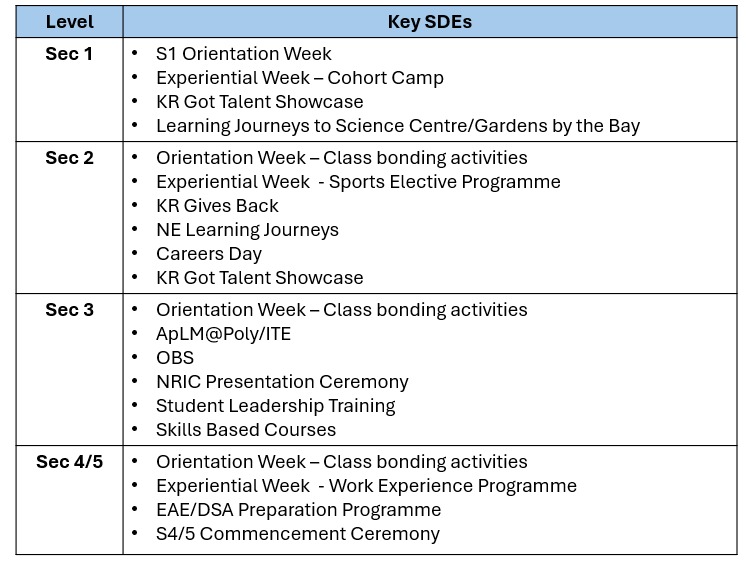
2. CCE2021 Implementation
Key SDEs are designed to achieve CCE Learning Outcomes and 21st Century
Competencies.
3. Education and Career Guidance
Education and Career Guidance is a developmental process which facilitates
the acquisition of knowledge, skills and values needed to make informed
decisions at key education stages to successfully transit from school to
further education or work. Through ECG, social emotional competencies and
qualities of proactivity, adaptability and resilience are developed to
prepare students for the demands of the future workplace. The ECG curriculum
focuses on exploration and helps students understand themselves better
and guide their exploration of different education and career pathways.
Students learn to:
-
Be more aware of their skills, interests and abilities.
-
Manage relationships with people who have influence over their decisions.
-
Explore relevant courses of study.
-
Understand careers in different sectors.
The ECG curriculum is delivered as part of the Character and Citizenship Education syllabus. Students will receive at least four hours of ECG lessons each year.
Organised ECG Programmes include:
-
ECG counselling by ECG counsellor
-
Class/cohort-based ECG workshops by ECG counsellor
-
DPA, DSA, PFP, EAE talks for graduating classes by Institutes of Higher Learning
-
Learning journeys to Institutes of Higher Learning
-
Learning booths by Institutes of Higher Learning
-
Career Talks by industry professionals
4. Values in Action Programme – KR Gives Back
The school’s Values in Action (VIA) Programme is learning experiences
that support students’ development as socially responsible citizens who
contribute meaningfully to the community, through the learning and application
of values, knowledge and skills. VIA fosters student ownership over how
they contribute to the community. As part of VIA, students reflect on their
experience, the values they have put into practice, and how they can continue
to contribute meaningfully.
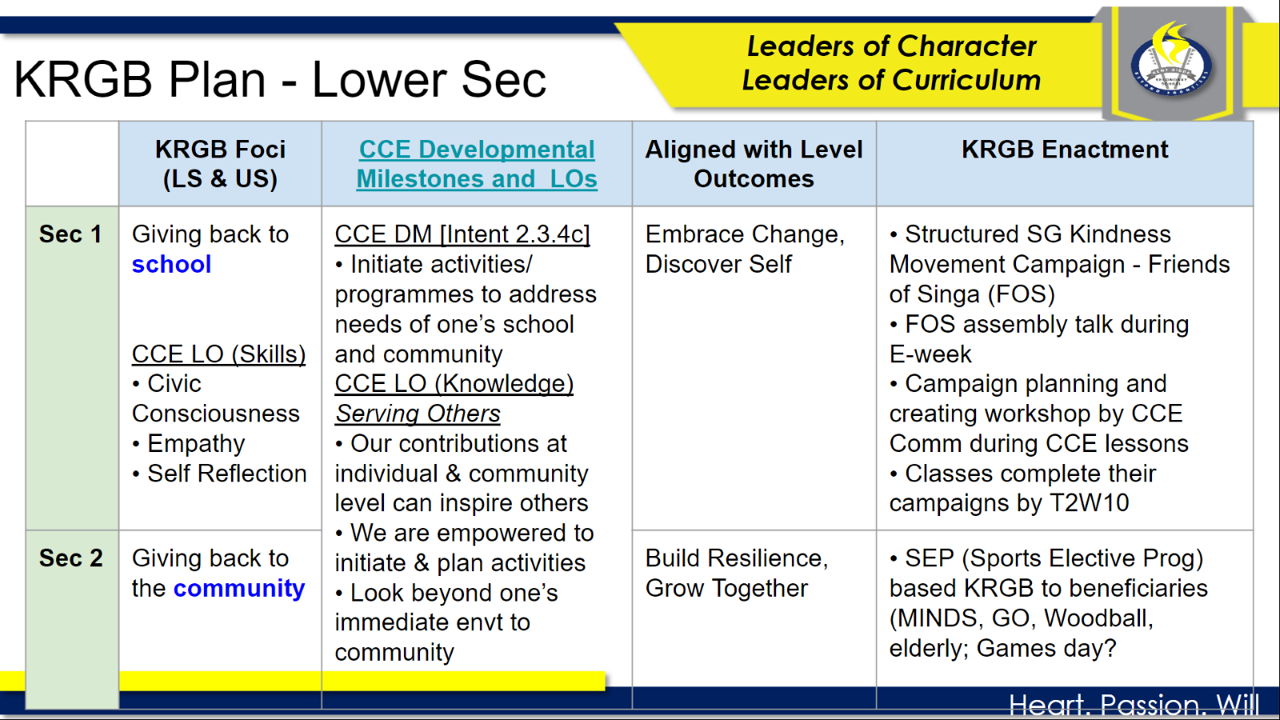
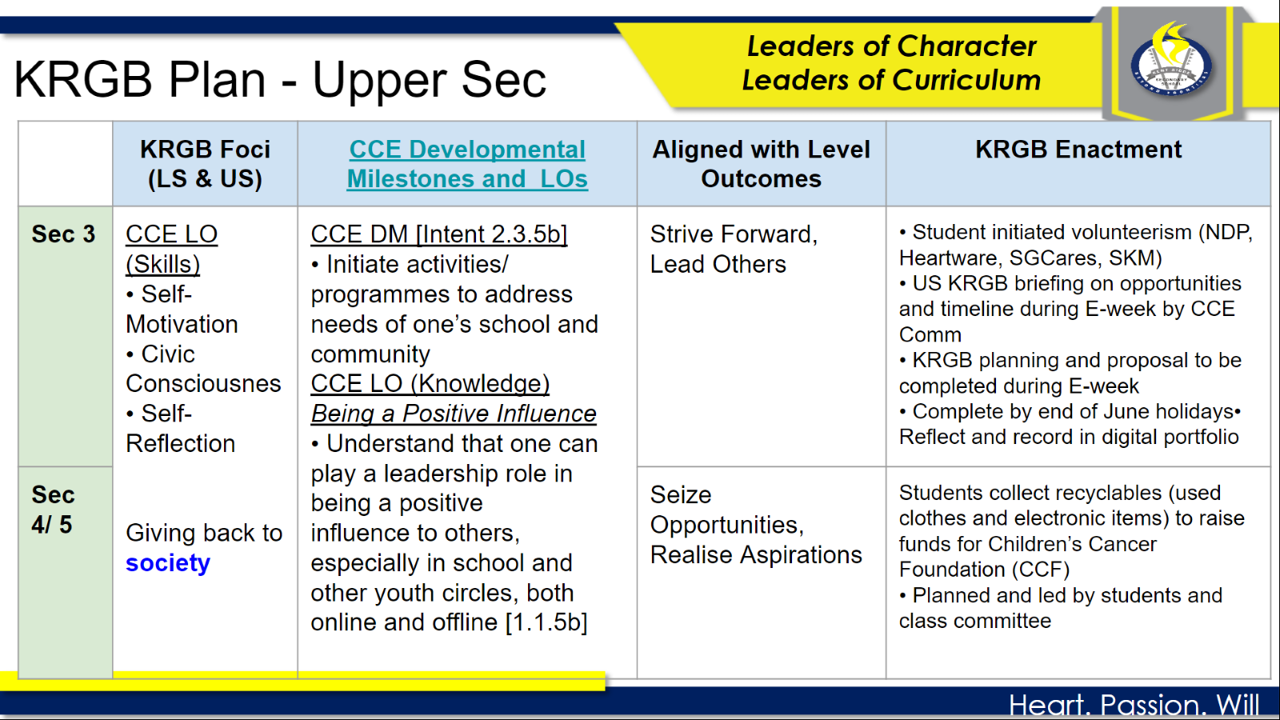
The school’s KR Gives Back (KRGB) programme provides students with the
experiential learning opportunity through customised VIA level activities
to live out their values, skills and SE competencies.
Student Management Committee
Kent Ridge Secondary adopts positive discipline and restorative practice as the whole school approach to setting expectations for all Kent Ridgeans. This drives the school in developing the following student management philosophy:
-
Students learn well when there is order and discipline. At the same time, they need care, encouragement and space to learn from mistakes and improve.
-
Student management is an educative process, and the goal is to instill self-discipline and good character in students.
-
Disciplinary measures serve as a proxy for consequences of the poor choices made. It is not punishment, and must be meted out fairly, firmly, and appropriately.
The student management team believes in setting high expectations, and providing high care and support for our students to achieve their aspirations.
Setting High Expectations
-
Every Kent Ridgean is capable of growth and can be nurtured to become a gracious citizen.
-
Every Kent Ridgean can be and is a resilient leader.
Be it in managing self or leading others, KRSS does not compromise on the expectations and standards we set for Kent Ridgeans. In our approach, we must be cognisant of the unique aspirations, hopes and needs of each Kent Ridgean and their circumstances. In helping them become best versions of themselves and impactful leaders of others, we must set expectations based on their aspirations, hopes and needs rather than standards we impose on them.
Providing High Care and Support
-
A strong culture of care which embraces diversity and inclusivity and characterised by strong Teacher Student Relationship (TSR) and Peer Support and Relationship (PSR).
Developing a culture of diversity and inclusivity through strong TSR and PSR allows us to create opportunities for us to mentor, develop, challenge and stretch Kent Ridgeans in different aspects of their behaviourial and leadership journey. A key approach is helping Kent Ridgeans to form positive support networks and focus on their growth. In KRSS, we provide various support systems for all Kent Ridgeans to achieve their aspirations.
School Based Consequences
-
Consequences are used to serve as a reminder of the poor choices made.
-
It is not punishment, and must be meted out fairly, firmly, and appropriately.
-
KRSS will consider appropriate disciplinary consequences that account for the students’ specific needs and helps them learn from the mistake.
Baseline Consequences for Very Serious and Serious Offences
|
Baseline |
Serious Offence |
Very Serious Offence |
|
First-time offenders |
|
|
|
Second-time offenders |
|
|
|
Subsequent offenders |
|
Baseline Consequences for Minor Offences
|
Baseline |
Minor Offence |
|
First-time offenders |
• Behavioural Contract; and/or
|
|
Second-time offenders |
|
|
Subsequent offenders |
Student Support Programmes
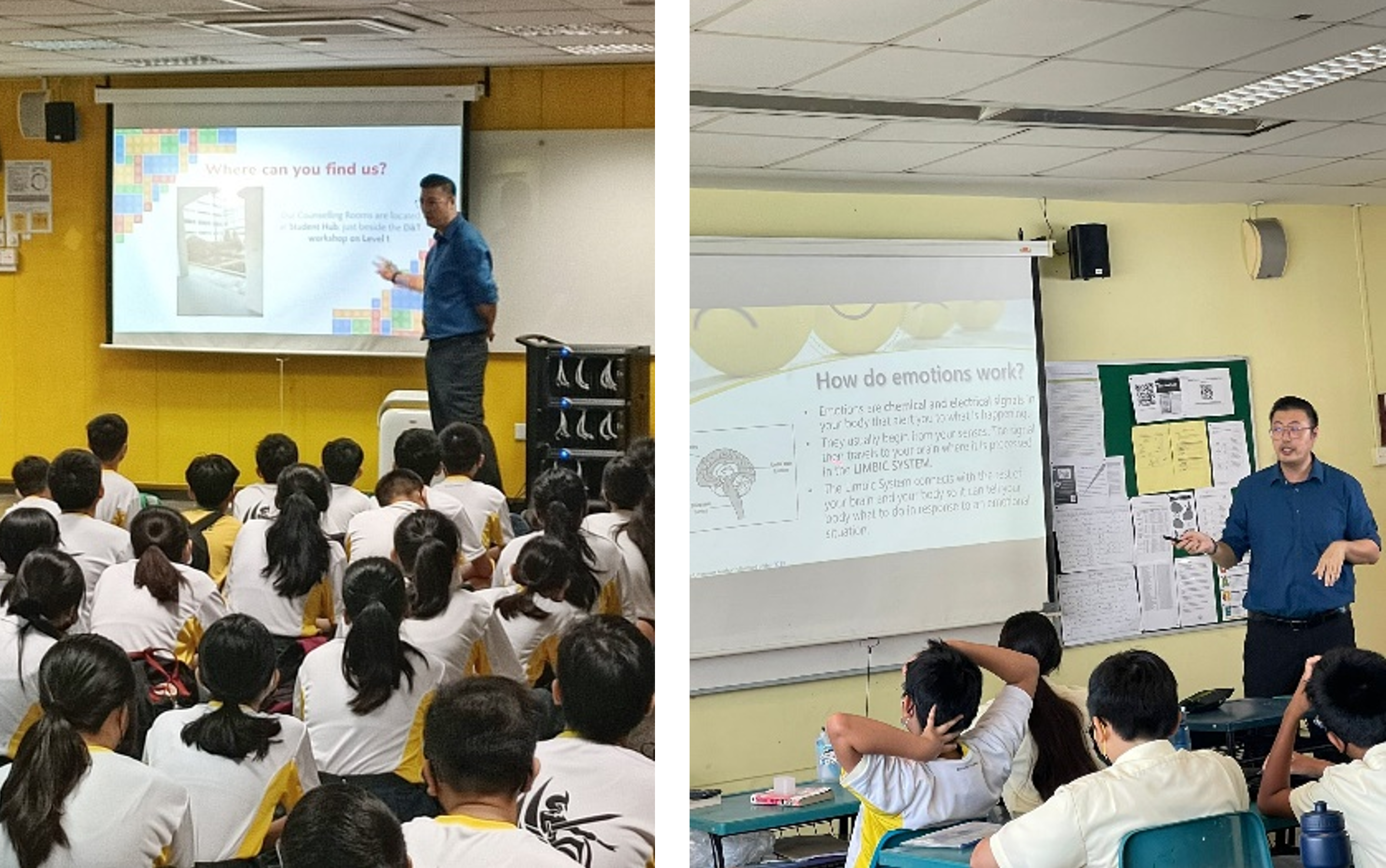
1. Social and Emotional Well-being
Student support structures in this aspect include Individual Counselling
Support, Secondary 1 Transition & Engagement Programme, Emotional Literacy
Programme and Secondary 4 Stress Management Programme.
Students are equipped with knowledge, skills and tips to manage self,
support their peers facing challenges as well as know the different avenues
to seek help.
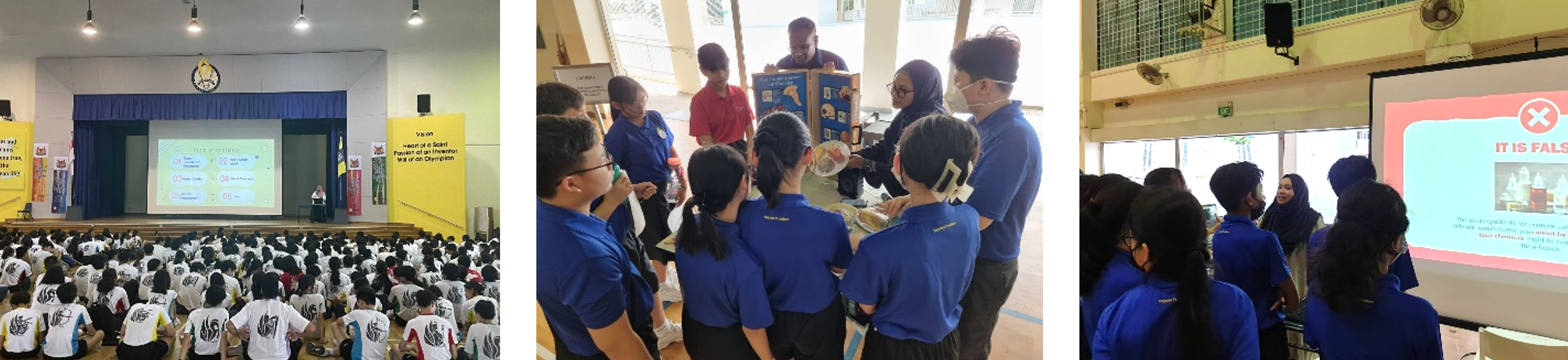
2. Physical Well-being
The Student Health Advisor (SHA) programme is run by a qualified and trained
allied health professional who provides guidance to students with health-related
issues so that timely intervention and referrals can be made. For more
information, kindly click on this link.
3. Financial Assistance Programmes
Financial needs of students are identified and supported through various
schemes, bursary applications and referrals to school partners.
4. Special Educational Needs Support Programme
We believe that every individual has unique potential and deserves the
opportunity to thrive in an environment of mutual respect and understanding.
Our aim is to create an inclusive school where every student can participate
and learn effectively.
Learning and Behavioural Support for students with Special Needs is provided
in the form of formal/informal assessment, in-class support and individual/small
group intervention support.
The team also plans schoolwide and customized programmes to cater to the
needs of different student segments. We also partner stakeholders to create
awareness, develop capacities and promote inclusivity.
a. Individual/Group Support Programmes
Learning and Behavioural Support
Intervention and support are provided based on the needs of students in
the areas of Literacy, Social Emotional and Behavioural challenges. Interventions
are carried out through individual or group sessions. Through collaboration
with various stakeholders such as parents, teachers and external agencies,
students learn skills and strategies to help them achieve personal and
academic goals.
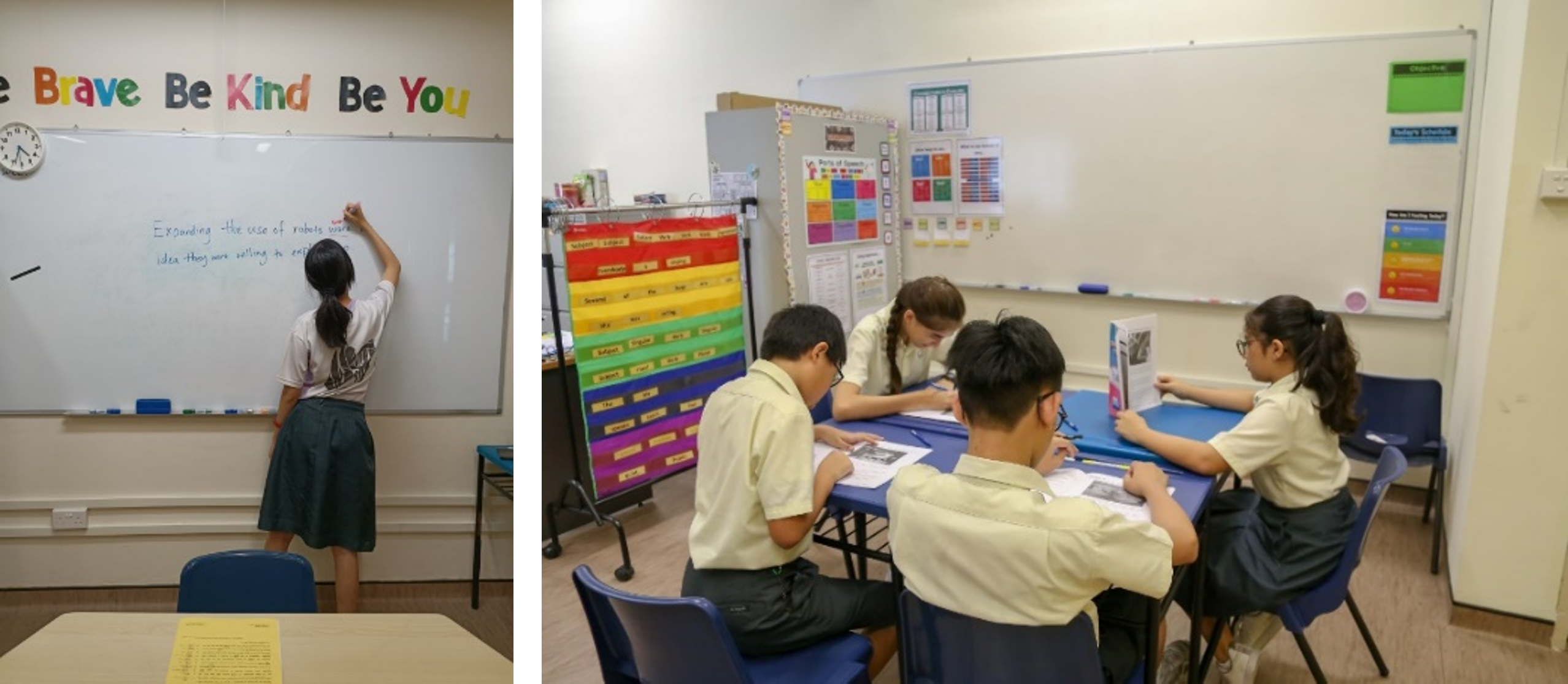
i. Language & Literacy Support
Students who require literacy and language support have various strengths
that can be enhanced, and learning gap that can be improved. Intervention
and support for them may include: Reading Fluency, Comprehension Skills,
Spelling and Writing Skills.
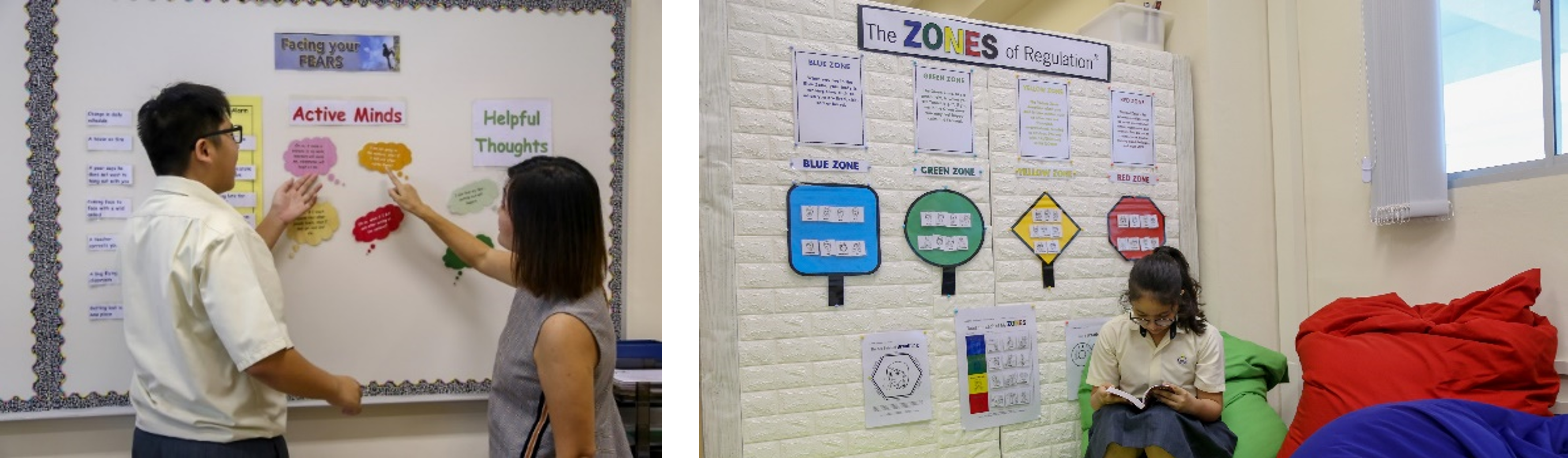
ii. Social & Behavioural Support
Students with social and behavioural difficulties may be engaged in individual,
peer or group sessions to learn skills and strategies. Intervention support
for them may include: Emotion Regulation Skills using Zones of Regulation,
Facing Your Fear Programme, Circle of Friends and Self-management programme.
b. Customised Programmes for students
• Sec 1 Student Induction Programmes
Through the induction programme, students get to know one another, understand
school processes and programmes as well as learn the different areas in
the school where they can seek help from the Student Support Team.

• Study Skills, AA Exam Briefing & Preparations, Social Skills & Self-Management Programmes
Through the various programmes, students learnt skills and strategies
to better manage themselves in their learning and peer relationships. The
programmes also allowed students to work in teams and forge greater bonds
with other SEN students across the levels.

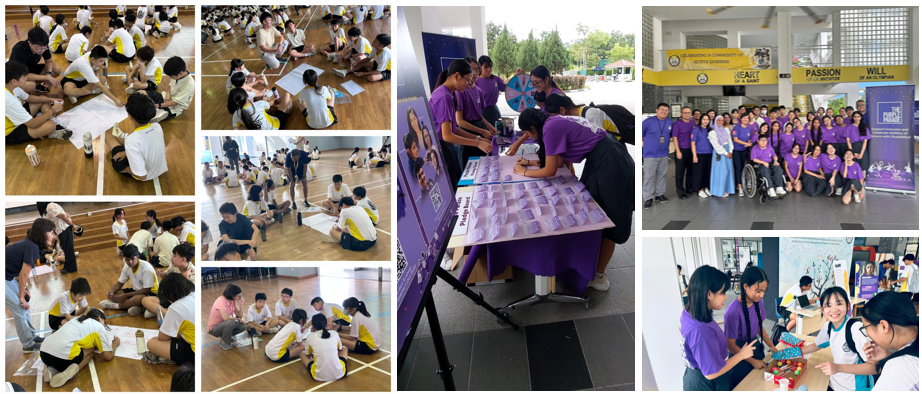
c. Schoolwide Programmes/Activities - Knowing Me, Knowing You
To create awareness and promote empathy and peer support for an inclusive
school culture, students learn about challenges their peers may experience
through various initiatives. These include SLS packages, simulation activities,
and information sessions designed to raise awareness and promote inclusion.
Students learn ways to be understanding, accepting, and helpful to peers
who face challenges in school. This year, we also organised activities
such as Purple Parade activation and autism awareness programmes to further
support our inclusive culture.
d. Partnership
Parents Induction
Sec 1 Parents are invited to a session where the SEN Team shares about
the SEN support provided by the school. The briefing session also creates
an opportunity for greater collaboration between parents and school as
we support students with SEN to have a smooth transition to secondary school.
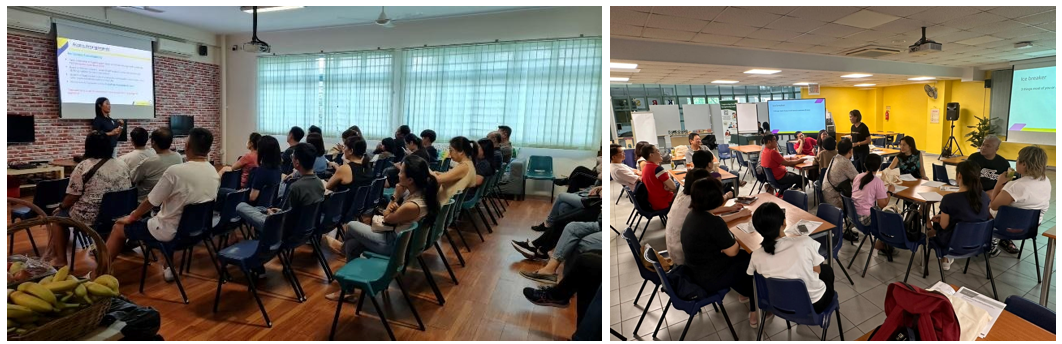
Parents Engagement and Support
We engage parents through various programmes to support their children's
development and promote inclusivity. These include workshops conducted
by external vendors and regular sharing of resources via Parents Gateway.
Our KMKY series provide parents with practical guidance on topics such
as working with their children on inclusivity and stress management. These
ongoing initiatives equip parents with knowledge and strategies to better
support their children at home whilst fostering a collaborative partnership
between families and the school.
5. GEAR-UP @ KR
To support the School’s Key Strategic Thrust 1 of Holistic Development
of Students, the school has an extensive GEAR-UP programme which targets
different segments of students with varied profiles, interests, strengths
and needs. GEAR-UP @ KR aims to engage Kent Ridgeans in meaningful after-school
engagement programmes to develop useful core skills and competencies, build
positive relationships with their peers, mentors and teachers while deepening
their passions so that they can strive towards achieving their aspirations.
GEAR-UP @ KR adopts the SOAR (Skills, Opportunities, Achievement, Recognition)
approach to engage students in meaningful activities. They are:
(a) KR Lighthouse
The programme aims to
-
provide a conducive environment for engaging students in school after curriculum hours;
-
allow opportunities for befriending and relationship-building among students, peers, adult volunteers, school personnel and with KR Lighthouse staff; and
-
provide opportunities for learning of social and life skills.
(b) Youth COP
The programme aims to
-
enhance youths’ awareness and knowledge of laws and crime prevention and
-
raise youths’ resiliency with life skills and competencies.