Learning for Life Programme
The Kent Ridge Secondary School’s Learning for Life Programme (LLP) titled Nurturing Leaders Beyond Frontiers, anchors on the schools’ belief that Every Kent Ridgean a Leader. It recognises that every student has the potential to be a leader and provides opportunities for students to develop leadership competencies through authentic experience in Student Development programmes.
The KRSS LLP focuses on developing every student into a leader who can influence others and contribute positively to the school and wider community. The objectives of Community & Youth Leadership LLP are as shown below.
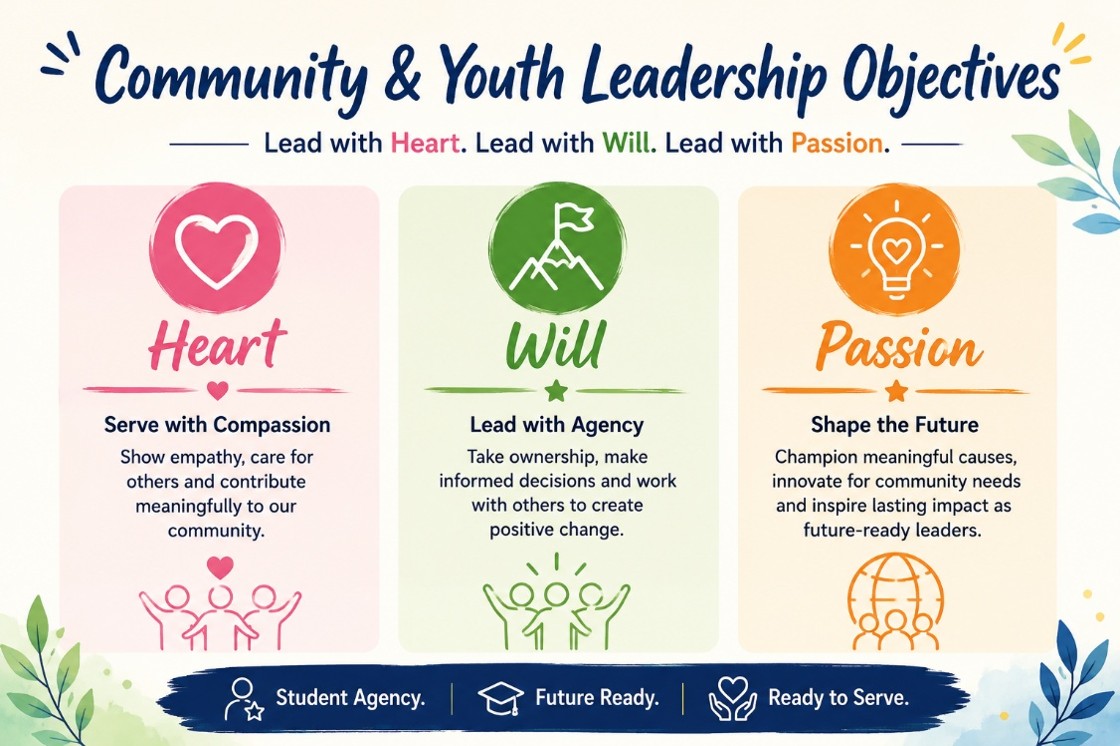
Objectives of KRSS CYL LLP
Anchored on the belief that Every Kent Ridgean a Leader, the Community & Youth Leadership LLP adopts a coherent and progressive approach to developing every student’s capacity to influence others and contribute positively, whether or not the student holds a formal appointment. The LLP is guided by the KRSS 5-4-3 Leadership Framework (Refer to figure below), comprising five contexts for leadership development, four Spheres of Influence and three tiers of leadership opportunities.
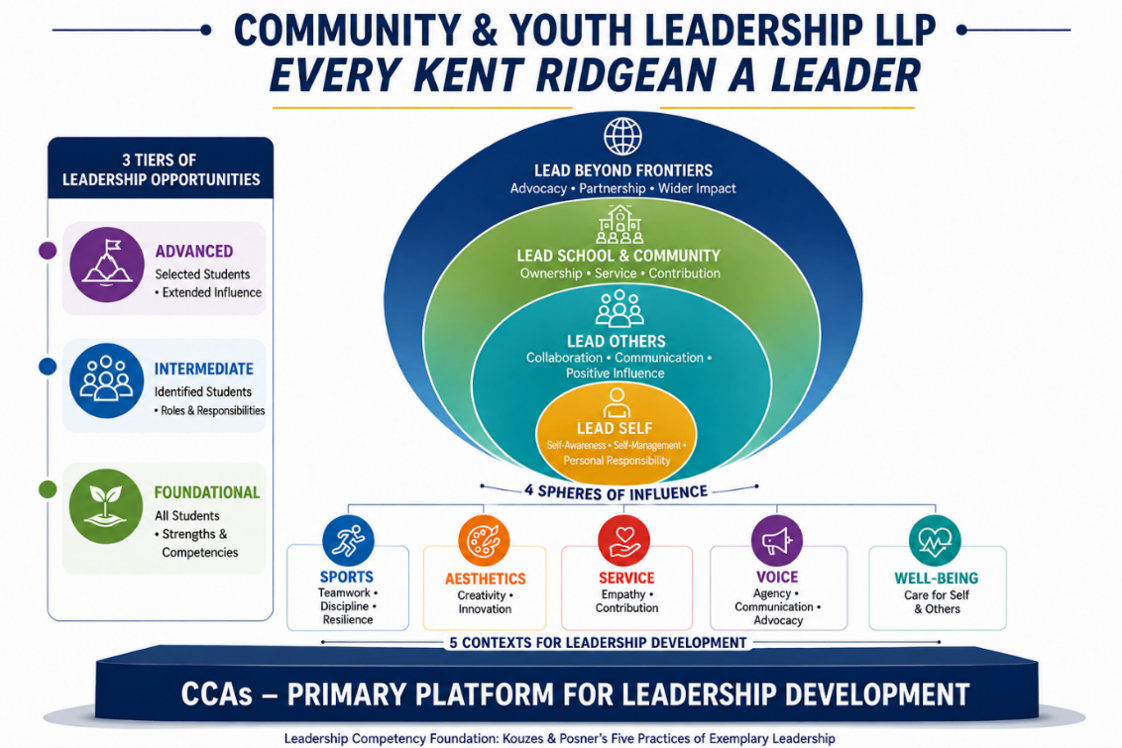
KRSS 5-4-3 Leadership Framework
Our Approach to Leadership Development
CCAs serve as the primary platform through which students experience authentic leadership and contribute to the community in the form of VIA projects. Through participation, collaboration, service and performance, students discover their strengths, develop leadership competencies and exercise leadership in meaningful contexts. Together, these experiences contribute to a coherent leadership journey across different aspects of school life.
Five Contexts for Leadership Development
Leadership is developed through five interconnected contexts that impact the community:
Sports: Developing leadership, through teamwork, discipline and resilience, to engage and contribute to the community.
Aesthetics: Developing leadership, through creative expression, innovation and collaboration, to connect with and enrich the community.
Service: Understanding the needs and contributing meaningfully to the school and community
Voice: Exercising agency through communication and advocacy on issues affecting the school and the community
Well-Being: Strengthening students’ capacity to lead themselves and care for others.
Together, the five contexts allow students to discover their strengths, develop leadership competencies and exercise leadership in diverse, authentic settings. They also enable leadership development to be integrated across CCAs, CCE, VIA, SDEs and other student development programmes rather than confined to formal appointments.
Four Spheres of Influence
As students develop their leadership competencies, they progressively broaden their influence across four spheres:
Lead Self
Lead Others
Lead School & Community
Lead Beyond Frontiers
The four spheres reflect the expanding influence and contribution that students can make as they grow as leaders. Students begin by developing self-awareness, responsibility and resilience before progressing towards influencing others, contributing to the school and community, and creating an impact beyond the school.
Three Tiers of Leadership Opportunities
Leadership opportunities are intentionally differentiated through three tiers to meet the varied readiness, interests and potential of students:
Tier 1 (Foundational): Leadership experiences provided for all students to discover their strengths and develop foundational leadership competencies, helping students to have a better understanding of how they can contribute to the school and the wider community.
Tier 2 (Intermediate): Authentic opportunities for student leaders (eg. Class Committee members, CCA leaders, PSLs, Student Councillors) to apply and strengthen their leadership by taking on a leading role in planning for and implementing projects that impact the school or community.
Tier 3 (Advanced): Extended leadership opportunities for student leaders (eg Student Council Exco) to broaden their perspectives and influence through mentorship of students, student-led initiatives, partnerships and experiences beyond the school.
The tiers do not represent fixed categories of students or a linear progression that every student must follow. They enable the school to provide an appropriate breadth and depth of opportunities while ensuring that every student has access to foundational leadership development.
Age-Appropriate Developmental Opportunities
Kouzes and Posner’s Five Practices of Exemplary Leadership provide a common foundation for developing students’ leadership competencies across all levels. The practices are developed cumulatively rather than taught in isolation. As students progress through the four Spheres of Influence, they apply these practices with increasing independence and sophistication, creating a wider impact within the community.
The table below attempts to highlights some key foci of the Community Youth Leadership development competencies for the school.
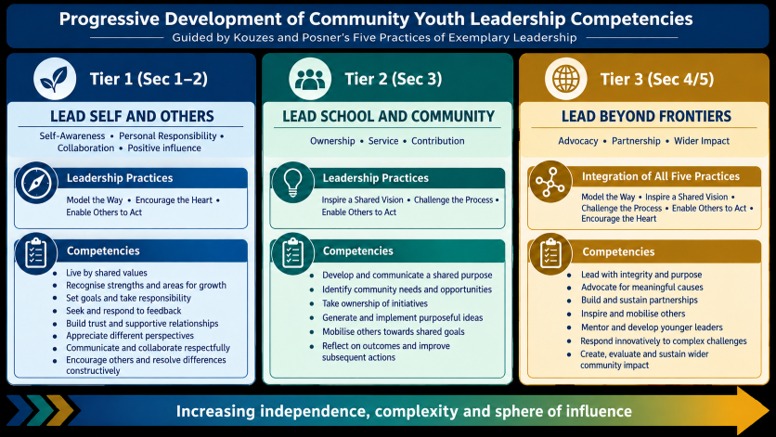
KRSS Community Youth Leadership Competencies